Showing posts with label Film. Show all posts

Saturday, November 10, 2018

Genre Classics No. 1 - John Ford's The Searchers


The Searchers (1956)
directed by John Ford


John Ford's The Searchers is a fascinating movie. It's a Western classic in terms of story and technical execution, with cowboys and Indians, chases on horseback, shootouts, a lone hero, and Ford's legendary use of location and epic wide/long shots - all things that make up the genre of the movie. But at the same time, this film seems to me like an early moment of Western revisionist thinking via its main character. John Wayne's Ethan Edwards is unlike many of the early Western heroes, and in my opinion, for a reason. Whether or not Ford meant to do this, I think audiences can view this movie as more than just genre entertainment, but in fact as a subversion of how The West as a concept is often perceived. By the end of the movie, Ethan "saves" Debbie and finishes his years-long obsessive quest, giving audiences a happy ending. However, along his journey, Ethan is one of the meanest, most negative, and most aggressively racist characters I've ever seen, contrasting what I would say is John Wayne's usual archetype. 

In the context of the movie, I don't believe Ethan's character was written to be so terrible for the sake of it. Instead, I think Ford's decision to make this "hero" such an unlikable character has more to do with the film's purpose for the audience. Disguised as a simple captive narrative, The Searchers seems to have an underlying message that the often over-romanticized idea of the "Wild West", and even the Western genre as a whole, should be analyzed critically rather than simply taken at face value as a mythology of morally-positive stories. Sure, at the end of the movie Ethan Edwards does his job and strolls back into the desert from whence he came, cool and quiet like an early Eastwood character. But should we really be happy at the end of this film just because Debbie was brought back to "humanity" and "civilization"? The death and hatred presented to us in this movie make me question why The West is so loved and memorialized, when it was really just full of terror and inhumanity. For example, Ethan doesn't face any consequences for his words and actions towards Native Americans because the people around him are probably just as terrible as he is. 

And that is at the root of the film's commentary on the West. John Ford made a living helping to create the Western genre as we know it today, but The Searchers seems so ahead of its time for being (what I think) almost anti-western in the way it showcases such a terrible person whom we're supposed to respect and be grateful for - a person who is never held accountable for his actions, no matter how bad they are. Of course, I don't think the "true" purpose of this film was to bash any type of person or create any contempt for either The West as an idea or the Western as a film genre. But I do believe that The Searchers can make us think about our values and perceptions of such things, while still presenting us with a story firmly rooted in the foundation of American, Western films.

Thursday, March 2, 2017

Contact: The Near-Great Zemeckis Sci-Fi (Film Review)


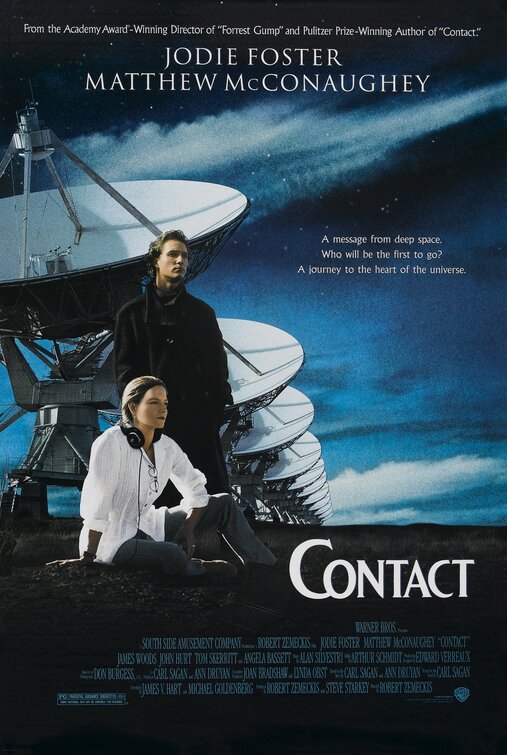
                   Image result for contact film poster

Released in 1997 and directed by Robert Zemeckis, Contact is a story about a scientist (played by Jodie Foster) who happens upon an extraterrestrial signal sent to Earth, after devoting years of her life to finding proof of an alien existence in the universe. Through a series of events, Foster’s character, Dr. Arroway, becomes the chosen human to make first contact with these otherworldly beings. Unfortunately, what is supposed to be the greatest discovery in human history turns out to be the most divisive event on the planet, letting loose religion and science to confront one another on a massively public scale. As Arroway is accompanied by a host of scientists and government officials throughout the movie, it's her relationship with Palmer Joss, a Christian philosopher played by Matthew McConaughey, which takes focus. While the film starts out as an alien-encounters picture, Contact soon becomes a meditation on humanity and belief, following Arroway’s journey to finding faith in something other than God. By the time the credits begin to roll, however, it’s clear that a decent script is one of just a few aspects which save the movie from falling too far short of greatness.

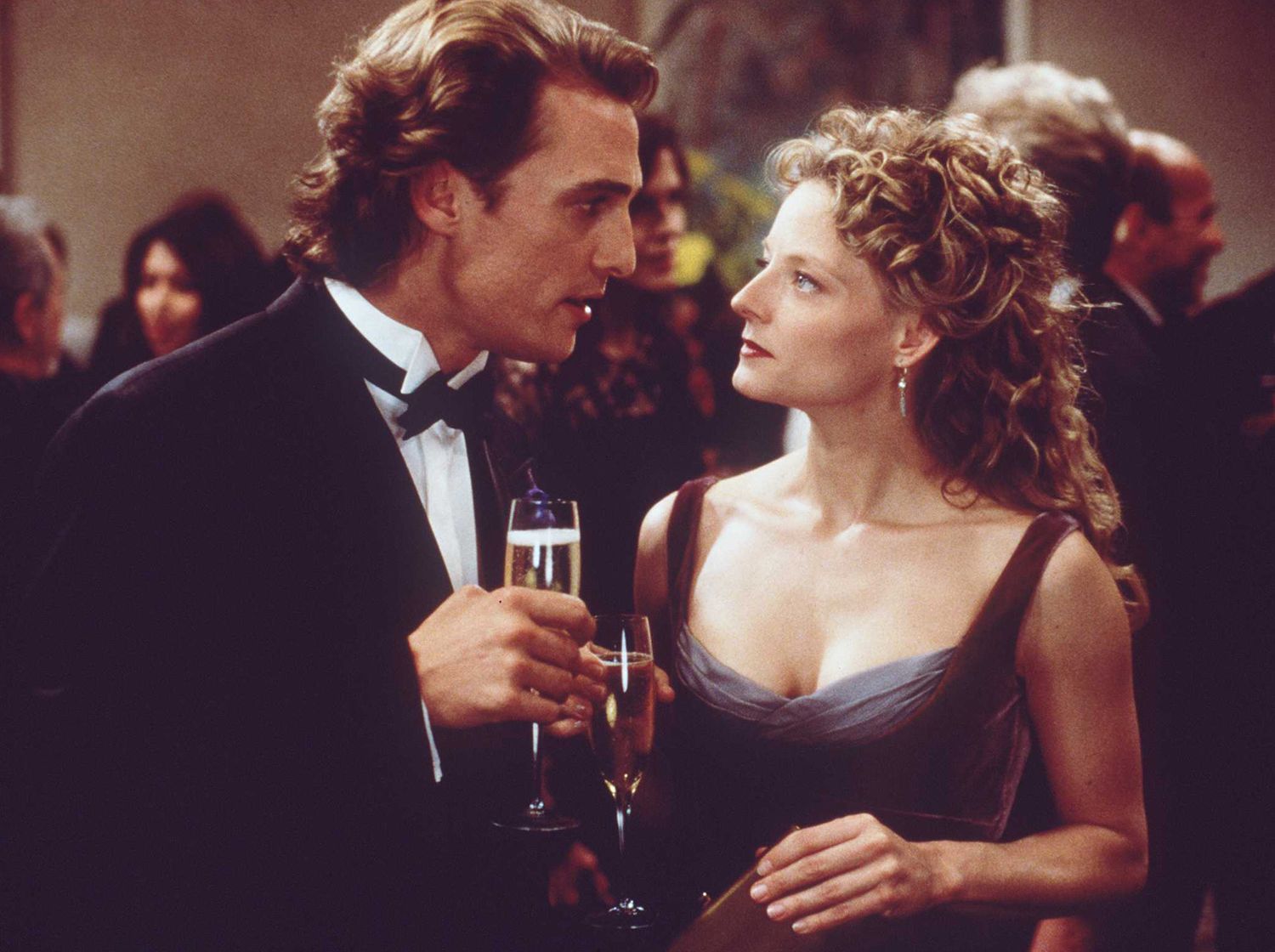
Image result for contact film

An interesting story grounded in the real world and peppered with hard science, what Contact largely presents itself to be is a movie less concerned with the aliens it speaks about, and instead focused on the humans an alien discovery would affect. But despite the film’s almost self-aware desire to separate itself from traditional science fiction fare, it struggles to draw a line between Hollywood blockbuster and the “thinking man’s movie” it wants you to believe it is. In fact, it’s so concerned with not being a run-of-the-mill Hollywood sci-fi that when it utilizes the very cinematic aspects it has seemingly been avoiding, those moments do nothing but negatively impact the story’s value. Yes, the slow pace of the movie can be attributed to its sense of detail in regards to its characters’ personalities and making sure that their world is as much ours as it is theirs. And the film is certainly an interesting take on the religion/science divide, dissecting what it means for the two fields to have dissenting universal truths. But as intellectually engaging as the film can be, Contact also employs some of the trappings of mainstream dramas. Romance between Arroway and Palmer tends to feel out of place; the use of John Hurt as a pseudo-James Bond villain becomes clearly unnecessary; and the machine’s overblown destruction sequence retrospectively seems straight out of a Michael Bay movie. If it wasn’t for the film’s run time spacing out these scenes, it surely would have turned into popcorn fodder for the casual viewer.

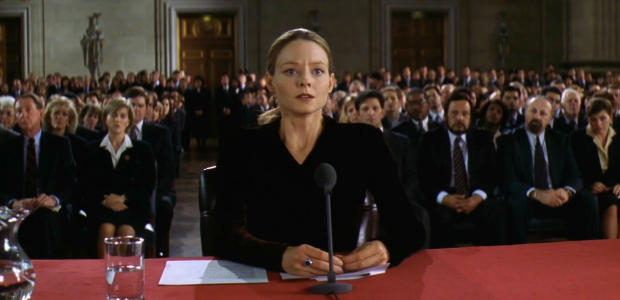
              Image result for contact film

Of course, even with its shortcomings, Contact is still a generally appealing film, thanks in great part to its lead actress. Arroway’s character is certainly supplemented by a supporting cast worth their own recognition, but the movie is undoubtedly carried by Jodie Foster’s brilliant performance. Known for her many standout roles as strong, independent women, Foster brings a serious tone and intensity to Dr. Arroway which keeps the character interesting enough to care about her. The story nearly opens and closes with monologues on her part, telling someone about how she’ll never quit her present endeavors. And throughout the movie, Arroway clearly has an affinity and love for the work that she does (even though she sleeps with Palmer in the first 20 minutes, she does leave him behind to track auditory satellite movement at three in the morning). Near the end of the movie, too, as it becomes less tethered to reality, Foster’s visual channeling of emotion becomes the thing which keeps us in our world, as she ironically leaves it behind, if only for a moment.

        Related image

While Contact does have a good buildup to a sort of ambiguous or unpredictable “climax,” it unexpectedly, and perhaps unnecessarily, takes the overdone, stereotypical Space Odyssey route and makes the last 40 minutes or so about this “experience” Arroway undergoes. It could have done more, or done something different, such as focusing on her actual thoughts rather than the spectacle of the travel, which ultimately only creates the situation where no one believes her, a very obvious outcome. It is also fairly slow moving, and often relies on clichés and seemingly random plot points or plot holes, but it’s an all around decent film. The subject matter is enough to stay intrigued, and Zemeckis’ down to Earth directing style allows for a grounded take on the epic sci-fi ideal. Hardly a perfect science fiction film, Contact may actually be the right sort of movie to introduce the genre to those who may flinch at man-killing cyborgs or look down upon epic space battles.


Rating: 3.5/5